Insurance companies have spent years trying to speed up policy processing. Yet many teams still rely on spreadsheets, email chains, manual data entry, and repetitive document reviews. It works, but only up to a point.
As customer expectations continue to rise, slow policy processing creates real problems. Applicants expect quick responses. Agents want faster approvals. Operations teams are under pressure to handle more work without increasing headcount. The challenge isn't a lack of effort. Most insurance employees already work hard. The issue is that too much of their time is spent on tasks that don't require human judgment.
Think about it. A policy application arrives. Someone downloads documents, enters information into multiple systems, verifies details, routes approvals, generates policy documents, and sends notifications. The same process repeats hundreds or thousands of times every month.
That's where AI workflow automation is changing the game. Instead of asking employees to manage every step manually, AI-powered workflows can handle routine work automatically, reduce errors, and keep processes moving without delays.
In this article, we'll look at how AI workflow automation helps insurance organizations eliminate manual policy processing and build more efficient operations.
What Is AI Workflow Automation in Insurance?
AI workflow automation combines artificial intelligence with business process automation. Traditional automation follows predefined rules. If a form is submitted, move it to the next step. If a field is missing, send an alert. AI adds intelligence to the process.
Instead of simply moving information from one place to another, AI can:
- Read documents
- Extract information
- Identify missing data
- Validate records
- Trigger actions automatically
- Route tasks to the right team
For example, an AI system can review an uploaded driver's license, extract relevant details, compare the information against an application form, and flag inconsistencies before a human ever gets involved.
The goal isn't to replace insurance professionals. The goal is to remove repetitive administrative work so people can focus on decision-making, customer service, and complex cases.
Why Manual Policy Processing Is Still a Major Challenge for Insurers
Many insurance organizations have modern customer portals and digital forms. But behind the scenes, policy processing often remains surprisingly manual. A typical workflow may include:
- Policy applications: Applications arrive from websites, agents, brokers, or email submissions.
- Data entry: Teams manually transfer customer information into policy management systems.
- Document verification: Employees review IDs, licenses, financial records, medical documents, or proof of address.
- Compliance checks: Information must be validated against company and regulatory requirements.
- Policy issuance: Approved applications move through multiple departments before policy documents are generated.
- Renewals: Existing customers require policy reviews, updates, and renewal processing.
- Endorsements: Changes to policies often involve additional paperwork and approvals. The problem isn't just time. Manual processes increase the likelihood of errors.
A simple typo in a customer's address or policy information can trigger rework, delays, and customer frustration. One small mistake can create hours of additional work later. Many insurers also struggle with staffing shortages. Teams are expected to process growing volumes of applications without proportional increases in resources. That creates pressure, and honestly, sometimes frustration too. The result is slower service, higher operational costs, and less time for employees to focus on customers.
How AI Workflow Automation Works in Insurance Policy Processing
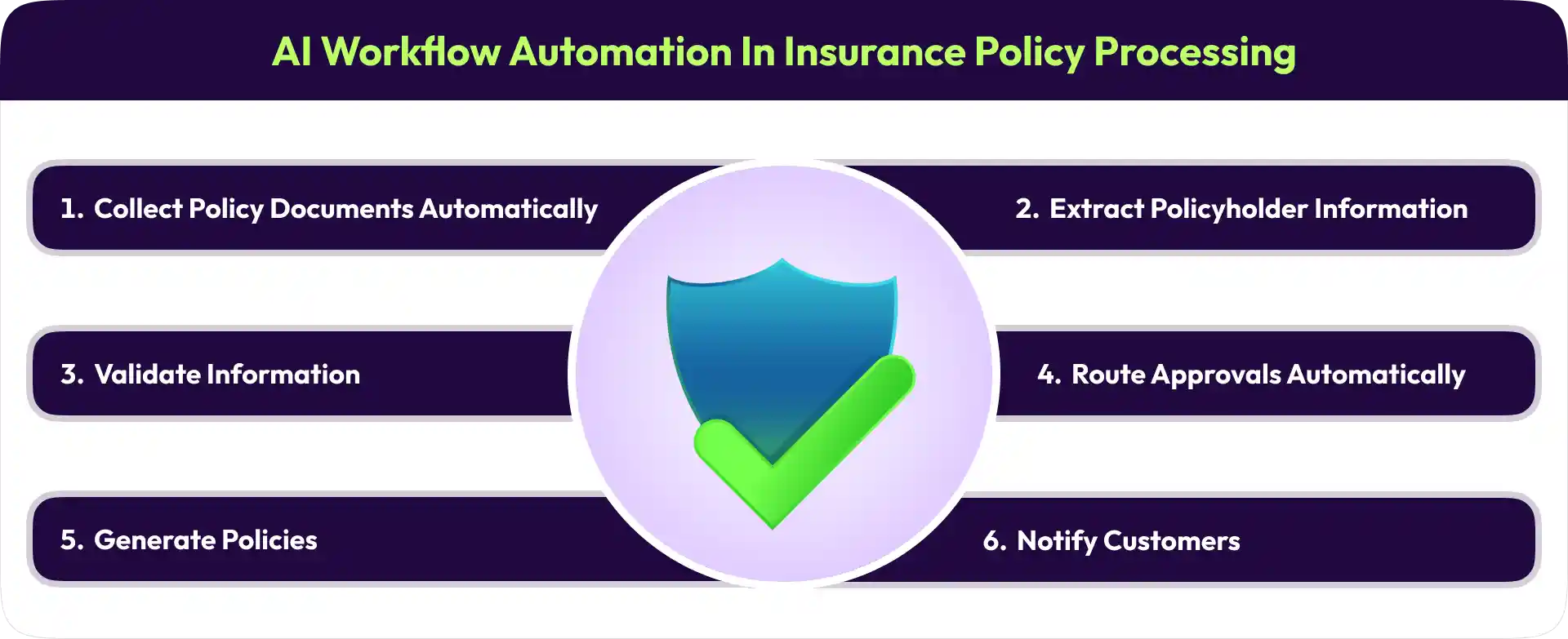
Let's break down a typical automated workflow.
Step 1: Collect Policy Documents Automatically
Customers upload documents through a portal, email, or mobile application. The system captures everything automatically.
AI reads submitted documents and extracts key details such as:
- Name
- Address
- Date of birth
- Policy information
- Vehicle details
- Business information
No manual typing required.
The system checks data against business rules and existing records. Missing information is identified immediately.
Step 4: Route Approvals Automatically
Applications are sent to the appropriate underwriter or department based on predefined conditions. No chasing approvals through email.
Step 5: Generate Policies
Once approved, policy documents are created automatically.
Step 6: Notify Customers
Applicants receive updates throughout the process. Everyone stays informed without manual follow-ups. The entire workflow becomes faster, more consistent, and easier to manage.
7 Ways AI Workflow Automation Eliminates Manual Policy Processing
1. Automates Data Entry
Data entry remains one of the most time-consuming activities in insurance operations. Employees often enter the same information into multiple systems. It's repetitive and, let's be honest, nobody enjoys doing it.
AI can extract information directly from submitted documents and populate systems automatically. This reduces administrative work while improving data accuracy.
Insurance workflows involve countless documents. Examples include:
- Driver licenses
- Medical records
- Vehicle registrations
- Business licenses
- Financial statements
- Proof of residence
AI-powered document processing can identify relevant information within these files and organize it for review. Instead of spending 20 minutes reviewing paperwork, employees can focus on exceptions and decision-making.
3. Speeds Up Policy Underwriting Workflows
Underwriters often spend significant time gathering information before they can assess risk. AI helps by collecting, organizing, and validating data before it reaches the underwriting team. Applications arrive with cleaner information and fewer missing fields. That means faster reviews and shorter turnaround times. For customers waiting on approvals, those time savings matter.
4. Reduces Human Errors
Humans make mistakes. That's normal. The problem is that even small errors can create larger operational issues. Incorrect addresses, missing documents, duplicate records, and incomplete applications all slow down policy processing. AI helps identify inconsistencies before they become problems. As a result, insurers spend less time correcting mistakes and more time moving applications forward.
5. Automates Policy Renewals
Renewals generate a large amount of administrative work. Teams must review policies, verify customer information, send notifications, and process updates. AI can automate much of this process. The system can:
- Identify upcoming renewals
- Send reminders
- Collect updated information
- Trigger review workflows
- Generate renewal documents
This keeps policies moving without requiring constant manual intervention.
6. Improves Regulatory Compliance
Compliance is a major concern for insurance organizations. Every step must be documented correctly. Manual processes increase the risk of missed requirements, incomplete records, and inconsistent procedures.
AI workflow automation helps create standardized processes. Every action is recorded automatically, creating detailed audit trails. When regulators request documentation, information is easier to locate and verify. That consistency reduces risk and improves operational confidence.
7. Provides Faster Customer Service
Customers don't really care how internal workflows operate. They care about outcomes. They want quick responses, timely updates, and efficient service. AI workflow automation helps deliver all three. Applications move faster. Status updates happen automatically. Service teams spend less time searching for information. The customer experience improves because internal operations become more efficient.
Still Processing Policies Manually?
Many insurance organizations know they need automation, but aren't sure where to start. Alris AI helps insurers automate policy workflows, document verification, customer communications, and operational processes using AI-powered automation solutions designed for insurance teams.
A simple workflow assessment can often reveal dozens of opportunities to reduce manual effort and improve processing speed.
Real Business Benefits of AI Workflow Automation
The benefits extend beyond faster processing.
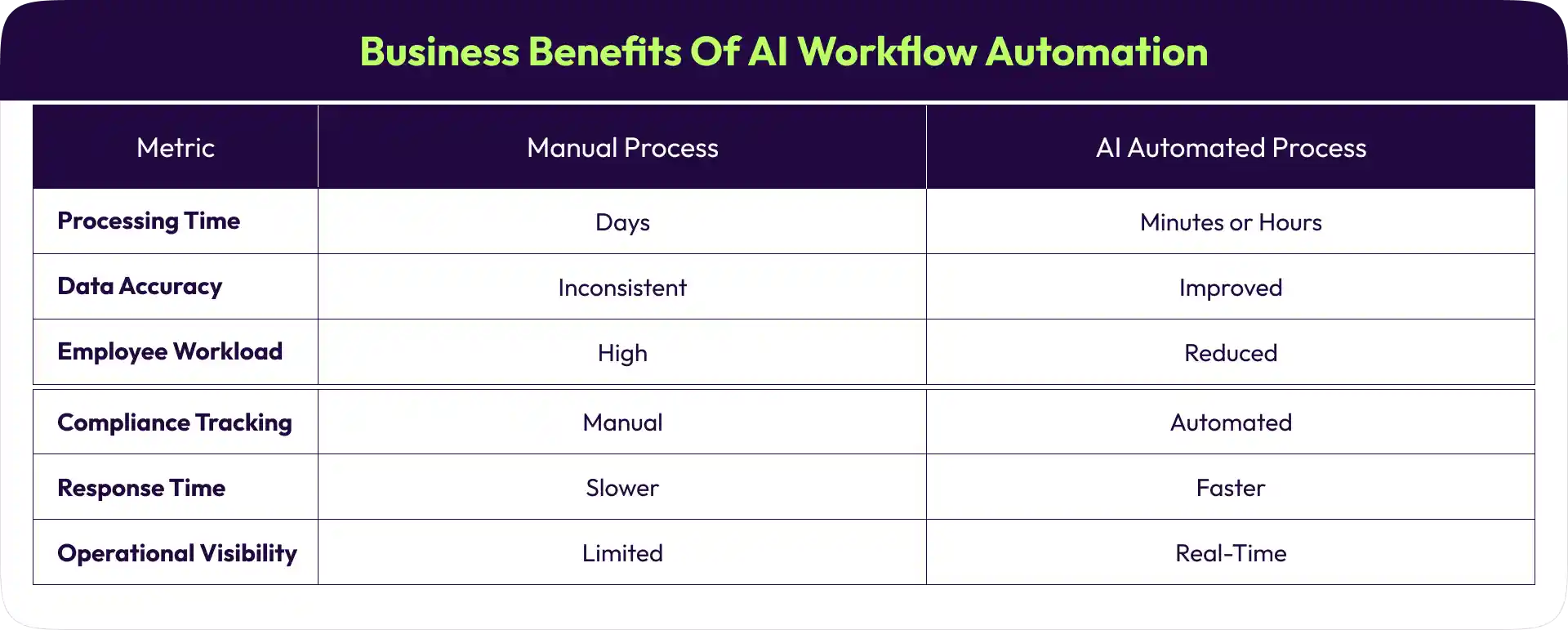
Organizations often discover that automation improves multiple areas simultaneously. Faster processing leads to happier customers. Better data quality reduces rework. Employees spend more time on valuable tasks. It's a ripple effect.
Real-World Insurance Workflows That Can Be Automated
AI workflow automation isn't limited to one department. Several insurance processes can benefit.
- New Policy Applications: Automate application intake, document collection, validation, and approvals.
- Policy Renewals: Reduce manual reviews and automate communications.
- Policy Endorsements: Process policy changes more efficiently.
- Underwriting Reviews: Deliver organized information to underwriters.
- Compliance Documentation: Maintain records and audit trails automatically.
- Customer Follow-Ups: Send updates, reminders, and notifications without manual effort.
- Agent Support Requests: Route requests and provide faster responses. The more repetitive the process, the stronger the automation opportunity usually becomes.
Common Concerns About AI Workflow Automation
Will AI Replace Insurance Employees?
Not likely. Most successful insurance organizations use AI to support employees, not replace them. AI handles repetitive tasks. Humans handle decisions, customer relationships, and complex situations. It's a partnership rather than a replacement.
Is Customer Data Secure?
Security remains a top priority. Modern AI platforms typically include:
- Encryption
- Access controls
- Audit logs
- Authentication protocols
Organizations should evaluate security practices carefully before implementing any solution.
Can AI Integrate with Existing Insurance Systems?
In many cases, yes. Modern automation platforms can connect with policy management systems, CRM platforms, document repositories, and communication tools. The goal is to improve existing workflows, not force organizations to rebuild everything from scratch.
How to Choose the Right AI Workflow Automation Partner
Not every automation provider understands insurance operations automation. When evaluating solutions, consider:
- Insurance Expertise: Industry knowledge matters. Insurance workflows are different from retail or manufacturing processes.
- Workflow Customization: Every organization operates differently. Look for flexibility.
- Integration Capabilities: Ensure compatibility with existing systems.
- Security: Review security certifications and compliance standards.
- Scalability: Choose a solution that can grow with your business.
- Ongoing Support: Implementation is only the beginning. Reliable support helps ensure long-term success. The right partner should understand both technology and insurance operations.
Conclusion
Manual policy processing creates delays, increases operational costs, and limits efficiency. AI workflow automation offers a practical way to address these challenges.
By automating data entry, document processing, approvals, renewals, compliance tracking, and customer communications, insurers can reduce repetitive work while improving accuracy and service quality.
The technology isn't about replacing people. It's about helping teams work smarter. For insurance organizations looking to improve efficiency without sacrificing customer experience, AI workflow automation is quickly becoming a necessary part of modern operations.

About Alris AI
Alris AI helps insurance agencies, brokers, MGAs, and carriers automate policy processing, customer communications, document management, and operational workflows through intelligent AI solutions.
Whether you're looking to streamline policy issuance, reduce administrative workload, improve customer experiences, or modernize insurance operations, Alris AI helps teams build efficient workflows that scale with business growth.
Frequently Asked Questions (FAQs)
1. What is AI workflow automation in insurance?
AI workflow automation in insurance uses artificial intelligence to automate repetitive tasks such as policy processing, document verification, data extraction, compliance checks, approvals, and customer communications. It helps insurers reduce manual work, improve accuracy, and accelerate operations.
2. How does AI help eliminate manual policy processing?
AI can automatically collect documents, extract policyholder information, validate data, route approvals, generate policy documents, and send status updates. This reduces administrative workload, minimizes errors, and helps policies move through the approval process faster.
3. What insurance processes can be automated using AI?
AI can automate a wide range of insurance workflows, including policy applications, renewals, endorsements, underwriting support, compliance documentation, customer communications, and agent support requests. The greatest impact is usually seen in repetitive, document-heavy processes.
4. Does AI workflow automation replace insurance employees?
No. AI is designed to support insurance teams by handling routine and time-consuming tasks. This allows employees to focus on customer service, underwriting decisions, relationship management, and complex cases that require human expertise.
5. What are the benefits of AI workflow automation for insurance companies?
AI workflow automation helps insurers reduce manual processing, improve data accuracy, speed up policy issuance, strengthen compliance, lower operational costs, and provide faster, more consistent customer experiences.