Summary: An AI phone answering system helps restaurants manage incoming calls, answer common customer questions, support takeout orders, and handle reservation requests. This guide explains five reasons US restaurants should consider voice AI in 2026, compares AI with traditional answering services, and covers the features, integrations, and costs to evaluate before choosing a solution.
Running a restaurant means dealing with several things at once. Your kitchen is busy, customers are waiting for their meals, someone needs help with a reservation, and the phone keeps ringing. Your team cannot stop serving guests every time someone calls to ask about the menu or book a table.
But when nobody answers, the caller may not try again. They might simply call another restaurant.
This is where an AI phone answering system can help. It answers incoming calls, responds to common questions, and supports tasks such as reservations and takeout orders, depending on its integrations and configuration. It can also handle calls outside regular business hours, when your staff is unavailable.
For US restaurants dealing with busy lunch services, weekend rushes, and after-hours inquiries, that extra coverage can make a real difference.
Let's look at five reasons restaurants should consider an AI phone answering system in 2026, what it can actually do, and how to decide whether it makes sense for your business.
What Is an AI Phone Answering System for Restaurants?
An AI phone answering system for restaurants is a voice-based assistant that answers customer calls, understands what callers need, and responds using conversational AI. Unlike a basic answering machine, it can have a two-way conversation and perform configured tasks rather than simply record a message.
For example, a customer might call to ask whether your restaurant is open on Sunday, book a table for four, or check whether takeout is available. The AI can answer routine questions and handle supported requests without requiring a staff member to pick up every call.
How Does It Work in a Restaurant?
The process is fairly straightforward:
- A customer calls: The system answers and greets the caller.
- It understands the request: The caller asks about a reservation, menu, opening hours, or an order.
- It responds or takes action: The AI provides the right information or completes a supported task through an integration.
- It confirms the details: The caller receives the relevant information or a booking confirmation when the workflow supports it.
- It escalates when necessary: Requests that need human judgment can be transferred to restaurant staff.
The important distinction is that answering a question and completing a transaction are not the same thing. A system needs access to the appropriate restaurant data and integrations to confirm a reservation or place an order reliably.
5 Reasons Restaurants Need an AI Phone Answering System in 2026
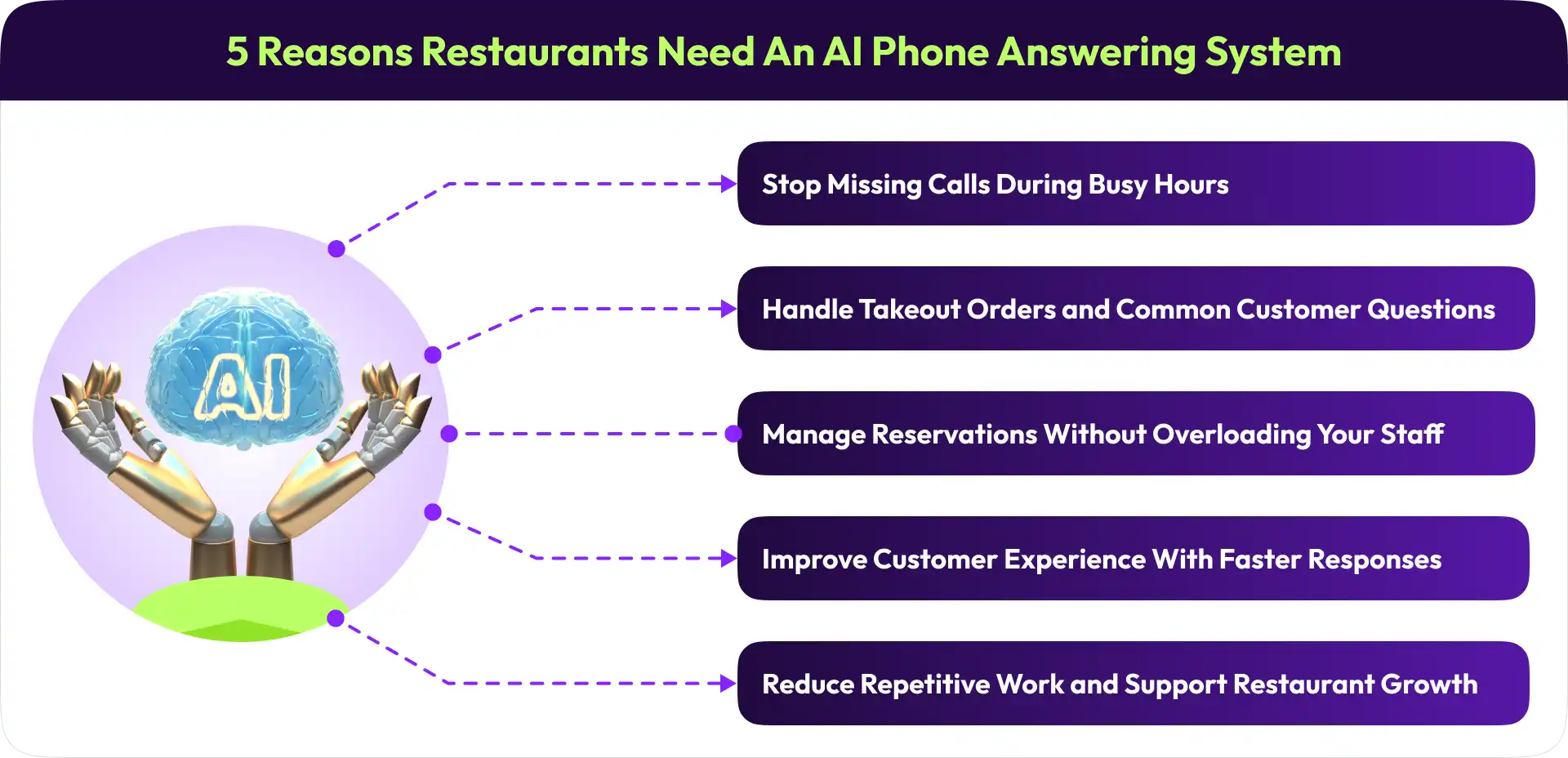
1. Stop Missing Calls During Busy Hours
Think about a typical Friday evening. The host is seating guests, servers are moving between tables, and the kitchen is working through a rush of orders. The phone rings. Nobody answers.
It happens more often than restaurant owners might like to admit.
A December 2025 report from Maple, based on more than 1.2 million calls across over 1,000 restaurant and local business locations, reported that restaurants missed 33% of incoming calls during peak service hours. This is a vendor's analysis of its observed call data, not a universal industry-wide rate, but it highlights a problem worth measuring in your own restaurant. Source: Maple's restaurant phone communication report. Source: Maple's restaurant phone communication report.
Those missed calls can represent reservation requests, takeout orders, catering inquiries, or customers looking for basic information before deciding where to eat.
An AI phone answering system can answer calls while your team focuses on service. Depending on its capacity and configuration, it can also handle several calls at once instead of placing every caller in a queue behind a busy employee.
That matters during lunch and dinner, when a few minutes of delay can be enough to lose a potential customer. It also helps after closing time. Someone planning a birthday dinner for next weekend may call late at night. With after-hours coverage, that inquiry doesn't have to wait until the next morning.
The first step is simple: find out how many calls your restaurant currently misses. That gives you a useful baseline for measuring whether automation is helping.
2. Handle Takeout Orders and Common Customer Questions
Restaurant phones aren't used only for reservations. Customers call to ask about pickup times, menu items, delivery options, allergens, opening hours, and daily specials.
Each question may take only a minute or two. Multiply that by dozens of calls, and the interruptions start adding up. An AI phone answering system can handle routine questions using approved restaurant information. It can explain opening hours, share menu details, provide pickup instructions, and answer other common inquiries when the relevant information is available.
Takeout ordering can go a step further. A suitably configured system may collect the customer's order, confirm item choices, capture modifications, and send the order to the appropriate system. However, actually submitting an order requires a compatible ordering or POS integration. Without that connection, the AI may be limited to answering questions or collecting details for staff to process.
Accuracy matters here. If a menu item is unavailable or an ingredient changes, the system should use current information rather than confidently giving an outdated answer.
Restaurants should also configure clear rules for allergy-related questions. The AI should rely on verified ingredient and allergen information and transfer questions to a qualified staff member when it cannot provide a reliable answer.
Done properly, this reduces repetitive phone work without making customers feel like they're talking to a machine that doesn't understand their needs.
3. Manage Reservations Without Overloading Your Staff
Reservations can be surprisingly disruptive during service.
A customer calls to book a table for six. Another wants to move a reservation from Saturday to Sunday. Someone else needs to cancel a booking. Meanwhile, the host is trying to manage arriving guests and keep the waiting area organized.
An AI phone answering system can help manage these requests without requiring staff to handle every conversation manually.
Depending on the system and its integrations, it can:
- Collect the preferred date, time, and party size.
- Check availability in a connected reservation system.
- Book, modify, or cancel reservations when those actions are supported.
- Send booking confirmations and reminders.
- Capture special requests for staff to review.
Imagine a couple calling at 10 p.m. to reserve a table for their anniversary. If your restaurant's booking system is connected and the AI is configured to use it, the reservation can be handled without waiting for the restaurant to reopen.
There is one important caveat: the AI must have access to accurate availability. A system that only collects reservation requests cannot guarantee a table. It should not confirm a booking until the reservation has actually been recorded.
For restaurants that receive frequent booking calls, this can reduce interruptions at the host stand and give customers a more convenient way to make plans.
4. Improve Customer Experience With Faster Responses
Customers don't usually think about how busy your restaurant is when they call. They simply want an answer.
Maybe they're checking whether you have outdoor seating. Perhaps they're asking if you accommodate a large group or whether the kitchen is still open. If the phone rings without an answer, they may assume your restaurant is difficult to reach.
An AI phone answering system gives customers another way to get help quickly.
It can provide consistent answers to common questions, explain basic policies, and direct callers to the right person when their request needs more attention. It can also offer coverage outside normal operating hours.
That last point is useful for restaurants in the US that receive calls across different time zones or have customers who plan meals well in advance. Still, faster responses alone don't guarantee a better customer experience. The answers must be accurate, the conversation should feel natural, and callers should have a clear path to a human when needed.
For instance, a simple question about opening hours can usually be handled automatically. A complaint about a food allergy, billing dispute, or serious service issue may need an employee's judgment.
The goal isn't to remove human interaction from hospitality. It's to make sure routine calls don't prevent staff from giving the guests in front of them the attention they deserve.
5. Reduce Repetitive Work and Support Restaurant Growth
Hiring and training staff takes time. During busy periods, every employee also has to make choices about what needs attention first.
- Should the host answer the phone or seat the waiting party?
- Should a server leave the dining room to explain the takeout menu?
- Should the manager pause a shift discussion to handle another booking inquiry?
These small interruptions can make an already demanding shift harder.
An AI phone answering system can take routine calls off the team's plate. Staff can spend more time serving guests, coordinating orders, and resolving issues that genuinely require a person.
The benefits may become more noticeable as a restaurant grows.
A single-location restaurant might need help covering evening calls. A group operating five or ten locations may also want consistent answers about opening hours, reservation policies, and menu information across its restaurants.
With the right setup, each location can use approved information and workflows while keeping location-specific details accurate.
AI can also create call records that help managers understand what customers ask most often. Frequent questions about parking, dietary options, private dining, or pickup delays may point to information that needs to be clearer on the website or menu.
Of course, automation isn't completely hands-off. Someone still needs to review call outcomes, update restaurant information, test workflows, and handle exceptions. The value comes from reducing repetitive work, not pretending that restaurant operations no longer need people.
AI Phone Answering System vs. Traditional Answering Services
Both options help restaurants manage calls when staff is unavailable, but they work differently.
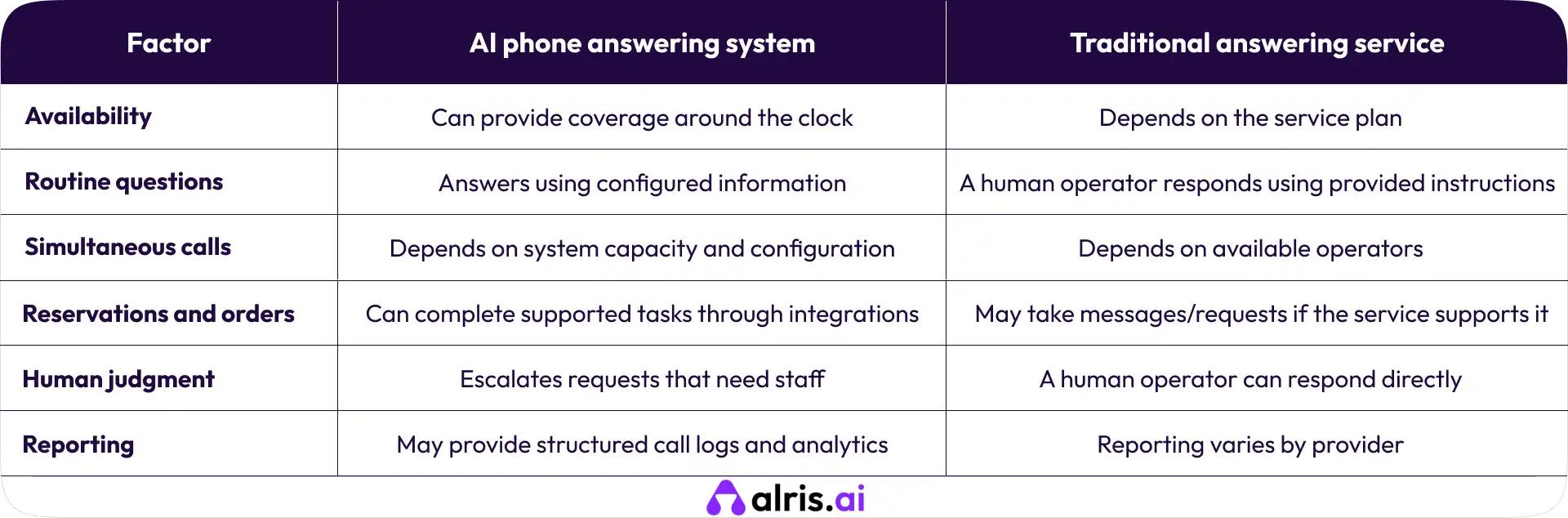
Neither option is automatically the right choice for every restaurant.
A traditional service may be a better fit when callers frequently need nuanced human assistance. AI may suit restaurants with high volumes of repetitive questions, reservation requests, and after-hours inquiries.
Some businesses may prefer a hybrid approach: AI handles routine calls, while employees or a human answering service manage complex situations. Before choosing, compare the actual capabilities, staffing arrangements, integrations, and total costs rather than relying on a general promise of savings.
What Should Restaurants Look for in an AI Phone Answering System?
Not every product that calls itself an AI receptionist can complete the same tasks. Restaurants should evaluate the system against their real operating needs.
Here are the main things to check:
- Natural conversations: Can it understand different ways customers phrase questions, including follow-up questions?
- Restaurant-specific workflows: Can it handle the calls you receive most often, from reservation requests to takeaway inquiries?
- POS and reservation integrations: Can it access current availability and submit orders where required? Check whether your particular platform is supported and whether the integration is live.
- Call transfers: Can it hand off complaints, complex requests, and urgent matters to staff?
- After-hours coverage: Does it answer calls when your restaurant is closed, including weekends and holidays?
- Call logs and reporting: Can managers review unanswered requests, common questions, and completed actions?
- Data privacy: Ask how call recordings, transcripts, and customer information are stored, protected, and retained.
- Transparent pricing: Check setup fees, usage limits, integration charges, and what happens when call volume increases.
Don't choose a system based on a polished demo alone. Test it with realistic calls, including a reservation change, a question about an unavailable menu item, and a request that needs human assistance.
Also, confirm the status of each integration before signing a contract. A listed integration may be in development rather than ready for production.
Is an AI Phone Answering System Worth It for Restaurants?
The answer depends on how many calls you receive, how often staff miss them, and what those calls are worth to your business.
Start by tracking incoming calls, unanswered calls, reservation inquiries, takeout requests, and the time employees spend handling routine questions. Then compare those figures with the system's total monthly cost.
For example, if your restaurant regularly misses reservation calls during dinner service, recovering even some of those bookings may justify testing an AI solution. But the result depends on actual customer behavior, booking conversion, operating costs, and how well the system works.
A practical way to evaluate the investment is to run a pilot. Record your current performance, introduce the system, and compare the results over several weeks.
Measure completed reservations and orders, not just the number of calls answered. A call that gets picked up but ends without helping the customer isn't necessarily a successful outcome.
How Alris AI Helps Restaurants Handle Phone Calls
Alris AI offers restaurant-focused voice automation designed to answer calls, handle guest inquiries, support reservation management, and assist with takeout workflows. It also connects guest communication across voice, SMS, and email. The actions it can complete depend on the workflow and available integrations.
For restaurant operators, the idea is straightforward: let AI handle suitable routine conversations so employees can focus on guests, food, and service.
Alris also provides workflows for confirmations, reminders, and follow-ups, helping restaurants connect a phone conversation with the next step instead of leaving everything for staff to manage manually.
Before adopting any solution, confirm that the features you need are available for your restaurant's systems and that the relevant integrations are ready to use.
Explore Alris AI's restaurant voice AI solution to see whether it fits your call volume and operating requirements.
Final Thoughts
An AI phone answering system can help restaurants handle missed calls, reduce repetitive questions, manage supported reservation and takeaway workflows, and give staff more time to focus on guests.
But the right solution depends on your restaurant's needs. Start by identifying where calls are being missed, which tasks take up the most staff time, and what you want to improve. Then test a system against those requirements.
You don't need to automate every conversation. Start with the calls that interrupt service most often and build from there.
Frequently Asked Questions (FAQs)
1. Can an AI phone answering system take restaurant orders?
Yes, some systems can take phone orders by collecting items, modifications, and pickup details. To submit orders directly, the system generally needs a compatible ordering platform or POS integration. Always verify that the integration supports the exact workflow you need.
2. Can AI answer restaurant calls after hours?
Yes. An AI phone answering system can provide coverage outside regular business hours, including nights and weekends. It can answer configured questions, capture inquiries, and support reservations when the required booking functionality is connected.
3. Can an AI phone answering system manage reservations?
Yes, provided it has the necessary reservation-system integration. Depending on the configuration, it may check availability, create bookings, handle changes, and send confirmations. Without access to live availability, it should not promise a confirmed reservation.
4. How much does an AI phone answering system cost?
Pricing varies by provider, call volume, features, integrations, and usage limits. Some charge a monthly subscription, while others use usage-based pricing or additional setup fees. Compare the full cost with the measurable value of recovered bookings, completed orders, and reduced staff workload.
5. Can AI transfer a call to restaurant staff?
Yes. Many systems support call transfers or escalation rules. Restaurants can configure them to route complaints, unusual requests, or questions that require human judgment to the appropriate employee.